|

|
||
|
|
October, 2002 | |
|
(Continued) - Becky Miklos Goes Back...
|
||
|
Tuesday, October 22, 2002, Yingtan
We left Nanchang early and arrived in Yingtan around 11 a.m., after a heart-stopping journey by car on a typical Chinese highway. The orphanage is new, and located in the countryside - fairly far from the city on a long, bumpy dirt road. The orphanage director and her assistant greeted us, and they gave us an overview of the current situation. The orphanage began in 1981. At the present time, it houses 23 children with special needs and 43 healthy infants. In May 2001, the new orphanage facility was built with a government grant of 5.3 million Yuan. Amity began work in this orphanage in August of 2000. Amity has arranged to take care of the medical needs of some children, provided a dryer, and generally has improved the lives of many. Amity currents sponsors three Grannies, 14 children in ordinary school, and 17 foster children. Amity also sponsors one in nursing school, and one deaf child who is a talented painter. Most of the children in foster care are doing very well. Of the total children sponsored in foster care, two have been adopted internationally, and two domestically. They are focusing on strengthening administratively to provide good training for the foster parents. We were told of one boy, FY, with cerebral palsy who was abandoned at one year of age when he was very disabled and seemed to have little hope. The Grannies worked with and exercised the little boy in the orphanage for a time, and then he was placed in foster care. Now he is getting fat and doing very well. |
|
I gave them the photos and letters I had brought from adoptive parents and a few gifts for some of the foster children from their sponsors. Then we were given a tour of the orphanage, beginning with a classroom for special needs children. They proudly showed us the lessons they were learning. |
|
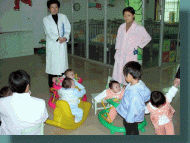
Then we visited a room that housed six children who were about one year old. When we arrived, the children were sleeping crowded together next to mats on the floor and covered with thick blankets. Wu An An was upset to see this. It was soon explained that the children were now developmentally able to crawl out of their cribs when they woke from their naps, and this was the safest way for them to nap. We were shown the adjoining room where their cribs were. The cribs had low sides and seemed small for the children by typical western standards. Next we were taken to one of the toddler rooms. It was really exciting because four of the children in this room would be traveling to Nanchang in a few days to be adopted by four families in my travel group. We spent some time trying to find out which children they were and I took some photos to share with the new adoptive parents. At noon, we left in the orphanage van and enjoyed a lunchtime feast at a local restaurant, then on to Shangrao, where my daughter Eva waited.
|
|
Journey to Shangrao First, a few words about the journey to Shangrao. The trip was supposed to take two hours by van. At the two-hour mark, we were stopped in a sea of vehicles, each trying to inch ahead anyway possible. You couldn’t tell where the road was as trucks, cars, motorcycles, buses all pressed together through narrow passes while a steady stream of the same zoomed by from where we were trying to go. At last we got to the place where the road had washed out, and vehicles continued to pass, creeping forward and stubbornly clinging to what was left of the roadway. You can bet I was praying when at last it was our turn. The last three miles of the trip were off-road down a bumpy dirt path, which in the darkness and by the violence of the jostling of the van, could have been a dried up creek bed. We finally emerged onto a broken, pot-holed stretch of pavement, which was even bumpier and strewn with enormous piles of rusty metal and concrete “stuff.” At last we emerged onto a real road where the traffic buzzed and dodged every which way, and within minutes we were at our hotel. I did a lot of praying on the roads of Jiangxi. That night, we had dinner at the hotel with the Shangrao orphanage director, Madame Zhu, and her assistant. Wu An An explained that I would be adopting RYP in a few days in Nanchang, and Madame Zhu exclaimed: “She is the prettiest girl in the orphanage.”
|
|
Wednesday, October 23, 2002, Shangrao I awoke with my heart in my throat. Would we see my new daughter today? Would she be OK? How would Sarah react? How would I react? How would I bear to leave her until Sunday? The orphanage van picked us up and drove us the short distance to the orphanage. I videotaped out the window, intending to capture Shangrao for my new daughter. It was apparent that the city was changing, adding sewers, widening roads, and becoming westernized. We turned down a bumpy dirt road and An An said, “It’s just a little bit further now.” I swung the video camera to the left and there were the orphanage gates, familiar to me from some photos other adoptive families had recently shared on the Internet. The driver honked the horn, a sleepy looking man emerged from a small room on the left, and the gates swung open. |
|
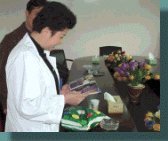
We were led inside and upstairs to a meeting room where we sat at a conference table with Madame Zhu and her assistant while they gave us an overview of the orphanage. Again, I shared photos and letter from adoptive families, and gifts for some of the foster children from their sponsor families. |
|
|
|
We were told that the orphanage is in a new facility, completed in October 2002. The grounds contain two buildings: the front one of 2,500 square meters houses the children, and the rear one houses the elderly. There are 80 children in the orphanage, half with special needs. There are 30 staff members. Amity has been involved with the Shangrao orphanage since 1999, when it was in the old facility. Amity provides foster care, medical needs, and tuition. Amity began sponsoring foster care children in May 2002, when 20 children were returned to the orphanage due to lack of funds and Amity agreed to sponsor their foster care. Amity also sponsors two nurses, 3 Grannies and 16 school tuition children. They also recently raised funds to purchase a dryer. All of Amity’s programs have produced very positive results, especially the foster care program. When the children came into the program in May, many of were not doing well. Amity required the orphanage to do a lot of follow up with the children at first, and now the condition of many of the children is much improved. They gave us the following examples: RMM, a girl born in 1997 with cerebral palsy, could not walk and showed little response to people. She is now walking and we visited her later that afternoon. RWW, a boy born in 1999 with cerebral palsy, was severely disabled when he first came to the orphanage. He is now very much improved may be able to be placed for adoption. RXX, a girl born in November 2001 with a heart deformity. She has had heart surgery and is much improved living with her foster mother. We visited her later in the day and she was a very bright, happy, lively little girl. Her name has been sent to CCAA for the waiting child program. We are told that the three Grannies and two nurses work very hard and are very committed to their work of improving the lives of the orphanage children. One of the Grannies is especially good with new arrivals who have special needs. All three Grannies treat the special needs children as they would their own grandchildren. Of the 16 children receiving school tuition from Amity, two are deaf children who study at a school in Zhejiang Province, two hours away by train. One boy and one girl attend this school that is new and a nice facility. They are very clever in school and they want to invest in them. Another girl is in nursing school, which costs 4,000 Yuan. They had to pay the tuition before Amity approved the use and provided the funds. This may still be a need. Eleven children who live in the orphanage attend school. They would like a fourth Granny to help them with their homework. This would be a new need. They told us about some medical needs. RHX, a girl born September 30, 2001, needs surgery for her cleft lip and cleft palate. Her file has been sent to CCAA, but they’d like to do the surgery now. RHH had surgery and has been adopted. The surgery remains unpaid for. |
|
A little girl in the orphanage was born with an extra digit. When she arrived at the orphanage the extra digit was infected and had to be removed. Now her left arm has a problem and one surgeon suggests surgery is needed. A child who recently came to the orphanage has three digits on hands and feet. This child is already in trial foster care, and they would like funds to add permanently. Another child who recently came to the orphanage has congenital heart disease. This child is also in trial foster care and they would like funds to add permanently. An An suggests we visit both children. RJH, a girl born in June 1994 with mouth/jaw deformity. She was in foster care and returned to the orphanage 8 years ago, but stayed in touch with her foster family. At An An’s suggestion, she was returned to the foster family and supported by Amity donations. Now school districting is a problem because she has to go to school near the orphanage. She has already returned to the orphanage so that she can go to school. Her foster care spot has been taken by a five-year-old girl with Down Syndrome. She lives with a rural family where the schools are more accepting. An An worries that at this age it is too late for this child to attach to her foster family. |
|
AT LAST, the meeting ended and we were led downstairs and then through a gate to the baby rooms. Outside one of the doors, An An tells me: “YP is inside.” Sarah rushes in, while I try to change from shoes to slippers and fumble with video camera. When I get there, An An has YP in her arms, and Sarah is smiling and touching her. I hand my mom the video camera, and gently touch the cheek of the child who will be my new daughter and Sarah’s sister. Sarah is giggling, while I am numb. YP is beautiful, as promised. She is handed to one of the caregivers who has a bottle ready. We are allowed to video and take pictures while she has her bottle. No one offers to let me hold YP, and I am afraid to suggest it, afraid that I won’t be able to let go again. I dig out a blanket I have brought for her and hand it to the caregiver. I take some pictures of the other children in the room, and try to find out which ones are being adopted by other families in my travel group. After a few minutes it seems it is time to move on and I say goodbye to YP. |
|
|
We walk down the hall to the next baby room, where there are more children who are to be adopted by families in my travel group. I try again to figure out which ones and take pictures for the families. The rooms are clean and calm and orderly and large, with the cribs pushed together in one part of the room behind a glass partition. | |
|
The children are clean, in matching outfits, and appear well cared for. I inquire about a travel mate’s baby and am told that she has a small illness and is in the medical facility receiving an IV so that she is healthy when she is adopted. So, that’s where we go next, and sure enough, YN is there with an IV in her hand, being attended to by the two nurses. Soon the IV is finished and the baby appears happy and healthy, with a small cold. We visit some more of the orphanage, seeing the beds that are too small, and the children who sleep in them. On our way out, YP is being held by one of the caregivers in the hallway outside of her room. Her caregiver walks to us, and stoops down for Sarah to see YP again. I take a few more pictures and whisper goodbye again. We’ll be together forever on Sunday, little one. |
|
After another feast at a local restaurant, we traveled out to the countryside to a small, poor rural village. Here we left the van and walked a short distance, entering what appeared to be a large two-car garage with a concrete floor. Shortly a crowd gathered as foster mothers entered with the children they care for. An An talked to each and shows me the child’s name on my list as I try to take photos a make a few notes. In all, we meet twelve of the twenty children on my foster care list and two others not officially in foster care yet. They are: RXX, RZZ, RYC, RYY, RJJ, RYL, RYY, RJH, a child missing digits and glottis, a recently abandoned girl suffering from heart disease, RYP and RFF. |
|
When the photos are finished we take a quick tour of the home. We see that a brick staircase has been built to accommodate a second floor that does not yet exist. The “kitchen” is a small open area at the back with brick walls, dirt floor, a primitive roof and wooden cupboards for food storage. We notice cooked, dry chicken pieces on the shelves, some roots and vegetables, and a large bowl of cooked rice. There is no refrigeration. We can hear sounds from a TV in the bedroom, but it appears that the only other source of light is one stark light bulb hanging from the ceiling in the large area where we met the children. There is a large earthen pot just outside the kitchen where An An surmises the family catches rain water for their use. An An explains that many of the foster children live in this small, poor village because this is where the former orphanage building was located. There is evidence of only one village telephone – in a small shop on the main road. The shop’s main commodity appears to be yarn for knitting. While we are there, school children pass on their way home from their lessons. They laugh and chat amicably as they walk, and call out “hello” to us. We pile back in the van and drive past fields, over a bridge, and down a dirt road, stopping near a rock wall. We are led through a passageway which has been carved into the rock and up a rock staircase to a pleasant apartment, which has been seemingly hollowed out of a large rock formation. Here we meet RFF, a mute girl whose legs have been disabled, and RJJ, a girl with cerebral palsy who was born in August 1999. The girls live here together with their foster parents. The foster parents were happy as they proudly showed us the children and told us of their progress. Next we walked back down the steps, outside and next door, to the foster home of RMM. The girl who was born in 1997 suffers from rather severe cerebral palsy, such that she needs to be propped up on a sofa with pillows around her so that she doesn’t fall off. She appeared happy and her foster mother was proud of the progress she has made in foster care. On the way back, the van stops at a large, modern shopping area where a broad, clean, pedestrian-only street is lined with trendy shops and dotted with food vending carts. As the sun sets, the bright neon and hip hop music pulsing from the stores make it seem like any upscale shopping area anywhere. Madame Zhu proudly leads us into an elegant department store, past the fragrance and jewelry counters and up to the baby clothing area. I purchase a pair of shoes and several soft cotton sleeping shirts for YP, but they don’t have any bottoms that aren’t split pants. Then we go downstairs to the food department, and Madame Zhu shows me which formula to buy for YP. Sarah eyes some jelly candies, and soon Madame Zhu indulges her with a large bag of the colorful treats. Then the van returns us to the hotel and Madame Zhu, her assistant and their driver stay to have dinner with us. This is the first night Sarah doesn’t fall asleep before dinner, and she has fun entertaining everyone with her songs and antics. Plain noodles and apple juice are ordered especially for her. I present gifts to Madame Zhu and I tearfully express my thanks for the obviously good care that YP has received in the orphanage. I promise that I will bring YP back to visit some day. |
| [Top] [ Previous Page] [Next Page] |